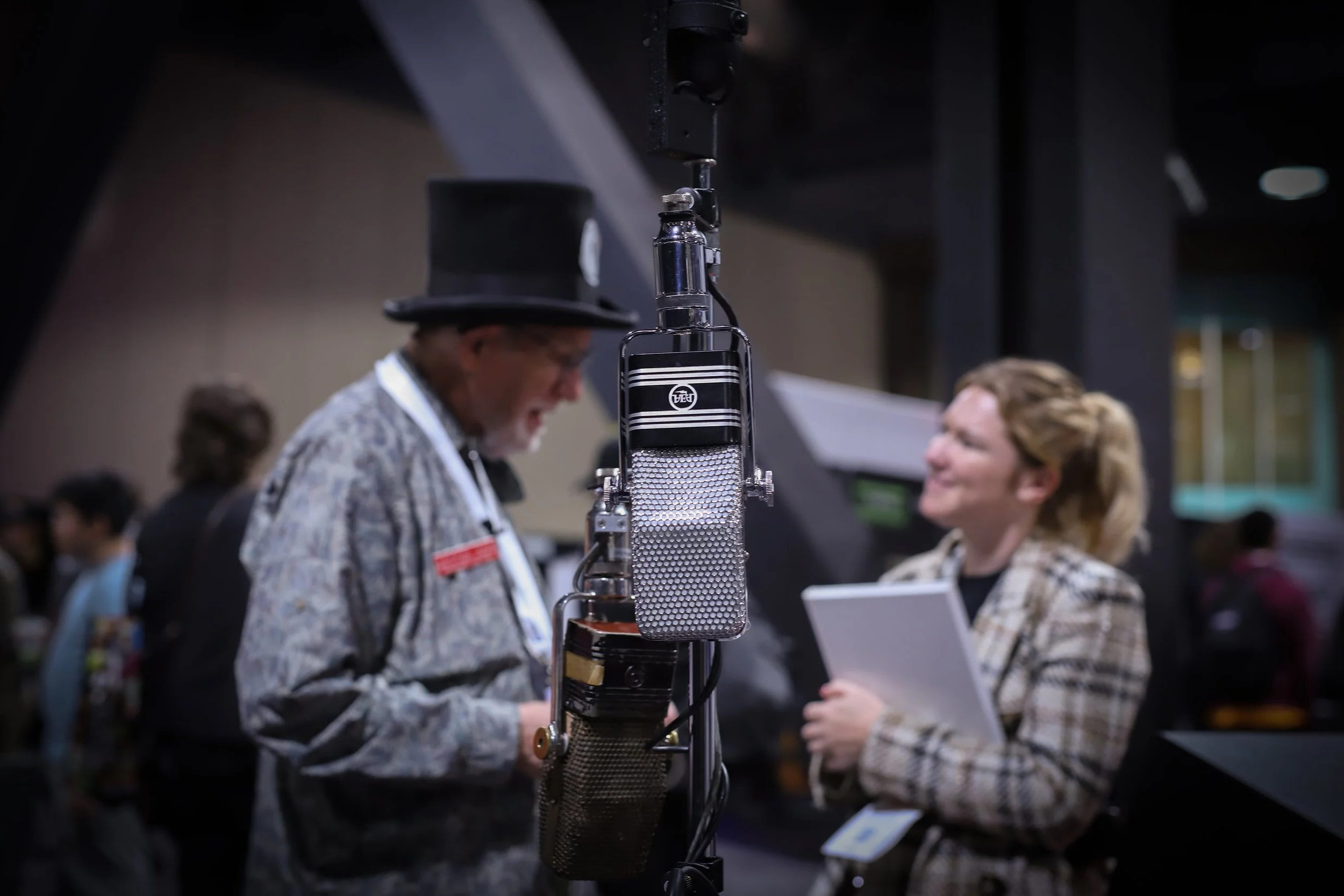
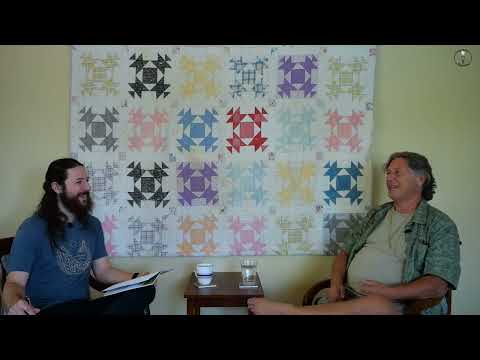
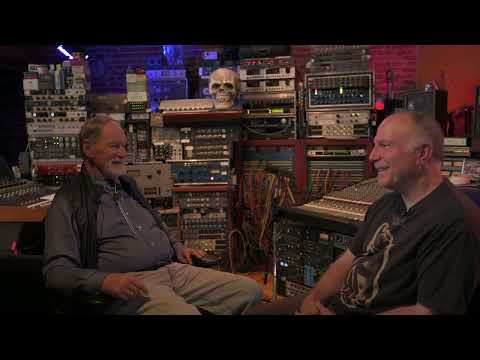
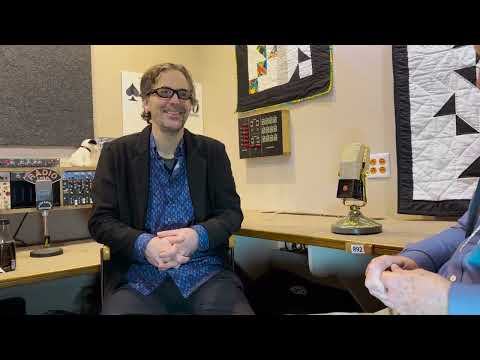
Looking back on the first 100 years of electrical audio recording, can reveal much about what the next hundred years will look like. Wes Dooley, founder of AEA Ribbon Mics, preserves and shares fascinating audio history through interviews with the very people who shaped it.
The History of AEA Microphones and preamps - Wes Dooley
As founder of AEA Ribbon Mics and Preamps, I’ve used, repaired, designed and manufactured Big Ribbons for almost 50 years. 20 years into repairing them, I had Nasopharyngeal cancer treatment that damaged my hearing. With 50/50 odds, and wanting to leave a legacy for Sara to share with William and Elizabeth, our six and ten year olds, I’m lucky to share that journey with you as well.
Jon Sank, RCA’s last microphone designer and production engineer, taught me to re-ribbon one of his 44BXs. I'm forever grateful to Richard Knoppow for introducing us. Jon passed on original ribbon material and forming tools from RCA Labs, to us, and asked us to share what we learned. This was comfortable for me, as for 10 years I’d gone to, and then organized AES meetings and workshops.
As a kid I’d enjoyed my Jr. high shop and drafting classes. At Pasadena City College I took electronics, art, and broadcast technology classes. Now the challenge was to teach others what I’d learned. For the 23 years Jon and I had spent hours discussing RCA ribbon mics via fax, and phone, and in his New Jersey lab. Mainly the SK46, 74, 44A, 44B/BX, 77D/DX, BK11, Variacoustic, and BK5.
Two friends, Richard Heyser and Dick Rosmini had owned the 44BX that was my muse as I developed the R44C. Heyser had used it to develop his TEF audio tests. TEF allowed him to measure in his living room, the 44BX polar pattern frequency response, down to its 90 dB null at 90 degrees.
When Heyser died of Nasopharyngeal cancer, Dick Rosmini bought it and fell in love with its natural sound on string instruments. An amazing string player and self-taught recording engineer, he pioneered home studios and essentially created TASCAM. His 44BX setup was similar to Shawn Murphy’s on Itzhak Perlman’s ‘Memoirs of a Geisha’ solos. Shawn used a closer Blumlein pair of AEA R44Cs and a Schoeps omni pair for room tone. Roz used his 44BX as his close mic, with an early tube B&K omni pair for the room.
Seven years after we lost Heyser, I too was in Nasopharyngeal cancer treatment and Rosmini was dying of ALS. After each treatment I’d visit, and we spoke of complex things we loved: our wives and microphones. I helped him sell his mics, and bought the 44BX. Over the next three years I took it apart, and measured and drew each part.
I faxed each drawing to Jon Sank who had taught me that:
All 44 dimensions would be fractional: the designers thought in fractions.
2, RCA’s sonic evaluations were done with live voice and music. They listened to the performer and put the mic in their favorite listening spot.
Then went into the adjacent room to hear how it replicated that sound.
During this period I began attending meetings of the AES Standards Committee Working Group SC-04-04 on Microphone Characterization, chaired by David Josephson of Josephson Engineering. I was way over my head being in the same room with legendary designers from Neumann, Microtech Gefell, AKG, Josephson and Audio Technica, but persevered.
Jackie Greene, then the amazing head of Audio Technica’s R&D crew in Stowe OH, taught me to pay attention to microphone’s structural resonances. Her crew in Stowe perfected that discipline. And, like my friends at JBL, she taught me a bit about magnetic circuits.
David Josephson pointed out the importance of carefully choosing a ribbon mics resonance frequency. He’d learned that from KPFA’s chief engineer. At 13 he’d walked in and asked if he could volunteer there. Like Jon Sank did years later for Wes, KPFA’s CE took apart a RCA 44BX and showed him how to change a ribbon and set the resonance frequency.
Years later, Charles Fisher described how he individually tuned the resonance point of each of his Cambridge ribbon microphones to best match what he heard where he had placed it. His test signal was his wife’s operatic soprano voice and her accompaniment using a harpsichord he’d built.
Our SC-04-04 meetings were twice a year at the US and the European AES conventions. Going to these meetings, and being an AES regional VP opened my ears to the worldwide reach of audio, and led to participation in Latin American and Asian AES and audio events. I was amazed and delighted to find my electrical audio tribe was worldwide and respected.
Through this period I also researched Southern California suppliers: from aerospace shops, to classic hot rod custom shops. Overseas I got to know the BBC’s research people at Kingswood Warren, and though AES service got to know Dr. Takeo Yamamoto, then president of Pioneer Electronics. He had designed loudspeakers and microphones for NHK, Japan’s equivalent of the BBC. He pointed out that like the BBC, NHK had done significant work with ribbon mics. As a result AEA began servicing the Japanese ribbon mics that NHK designed and used, alongside the BBC inspired 4038 and 4104 AEA was already importing and servicing.
We’d serviced RCA’s 1936-56 44B/BX for 20 years when Shawn Murphy, John William’s engineer, began listening to Wes’s R44C prototypes. His ears guided our efforts to match the sonics of Rosmini’s favorite RCA 44BX and Murphy’s favorite three 44BXs.
Introduced at the 1998 AES Convention in San Francisco, over the next 25 years an entire AEA family of Big Ribbon mics and preamps were developed. This Big Ribbons resurrection has helped engineers, musicians and producers create award winning projects around the world.
#1. R44C The R44 is mild street-rod version which matched the best of RCA’s 44B/BXs sonics and tuning, and added gold, neodymium and neoprene so it could last another 50 years.
#2 R44CX a real hot-rod with 6 dB more (100% increase) dynamic range. Custom built a pair for John Kurlander to maximize dynamics. For Lord of the Rings Howard Shore had asked John to change the normal Decca Tree scoring stage sound. He wanted it to sound like ancient music. John relied on his super dynamic R44CX pair to delivered a unique Grammy winning string sound for all three Lord of the Rings. Geoff Emerick told me he popped into the mix LOTR mix room that he asked John what got that sound John describe placing the R44CXs six feet high and eight feet back 45 degrees left and right from Howard’s conducting position and the Decca Tree. John said the R44CXs were quite forward, Howard had him bring them up to about 80% of the level of the Decca Tree.
#3 R84 Did Leon Bridges vocals on Coming Home and helped pay daughter (born 1984) Elizabeth’s tuition. Has the silhouette of the RCA 77D, the R44 ribbon & transformer, and higher HF response. George Massenburg tried and bought a pair, saying “this has HF response I’ve not heard from ribbons”.
#4 R88 Blumlein stereo ribbon with 40 kHz response that goes down below 20 Hz. A major player in the Turtle Island String Quartet’s A Love Supreme Grammy win, along with R44s and R84s. It helped pay son (1988) William’s tuition.
#5 R92 a compact nearfield big ribbon. After a guitar amp shoot out at Blackbird, they bought one of each studio. Marty Stuart’s standard guitar amp mic. Marty also loves his AEA Flagship A440.
#6 A440 AEA’s flagship custom 44 with extraordinary dynamics. Has a 21st Century high gain amorphous core Xformer, custom car shop umber finish, and unity gain P48 jFet buffer amp for driving long mic lines with no losses.
#7 A840 Our next Big Ribbon P48 hot-rod. Changed the name to R84A when we started building more active ribbons with the amorphous core Xformer.
#8 KU4A super-cardioid. A more consistent version of RCA’s KU3A. Charlie Gant built almost 600 of this1947 Voice of the Stars sound stage microphone design. I worked on it for years, and then working with Julian David we got it finished in two more years. Julian loaned it to Steely Dan at the Greek who liked it, and used it for months on their tour. Then returned shipped it back to Sara after their first night at Madison Square Garden. The next morning they called and gave her Walter Becker’s CC and their overnight FedEx information. It was a perfect one variable experiment. The result was they adopted AEA KU4As for Jim Pugh to use both for solos and the back line. And changed to AEA R84s for Walt Weiskopf and Roger Rosenberg on the saxophone backline.
Jack White used five as the only mic for his small acoustical ensemble tour.
**************
where tonights edit ended, will continue tomorrow
*********************
#9 N22 Ultra Nearfield Began 50th anniversary of Audio Engineering Associates
#10 Nuvo N8 minimalist End of 50th anniversary of Audio Engineering Associates
#11 KU5A an end-fire super-cardioid ribbon.
Other AEA Products
Optimized ribbon microphone preamps: The Ribbon Pre (TRP) and Ribbon Pre w/ EQ, the RPQ were our major projects. AEA also makes SMP: Stereo Mic Positioners, Modular Mic Array Hardware and Decca Trees. In the past they made MS Stereo electronics and very Tall Flite-Weight mic stands.,
Wally Heider taught me to search to interesting spaces to record in, so we optimized our designs for compact on-location recording.